


Recently, Professor Yu Ye's team from the School of Basic Medical Sciences and Clinical Pharmacy, in collaboration with Professor Yang Fan's team from the School of Basic Medical Sciences at Zhejiang University, published a research paper titled “Mechanism of capsaicin entry into buried vanilloid sites in TRPV1” in the internationally renowned academic journal Nature Chemical Biology. This study systematically elucidates the molecular mechanism by which capsaicin enters the deeply buried vanilloid binding pocket within the TRPV1 channel. It proposes an innovative analgesic strategy based on selective channel modulation, offering potential to overcome the challenge of high fever side effects associated with existing TRPV1 agonists in clinical applications (Figure 1).
Employing multidimensional techniques including free energy potential surface reconstruction, metadynamics simulations, fluorescence voltage clamp (VCF), patch-clamp recording, single-particle cryo-EM imaging, and animal behavioral experiments, the study identified a hydrophobic pathway formed between the TRPV1 protein and the cell membrane as the primary route for vanilloid ligands (such as capsaicin) to access the channel's binding site. Modulating the amino acid composition of this pathway or molecularly blocking this entry point can selectively delay agonist entry and optimize channel response, thereby achieving precise analgesia while avoiding thermoregulatory disruption.
Building on this, the team conducted virtual screening using a multi-million compound library, combined with electrophysiological and structural validation, to identify a series of candidate molecules with analgesic activity that do not induce abnormal body temperature. These demonstrate promising prospects for drug development.
This research not only deepens our understanding of TRPV1 channel function but also proposes a novel mechanism-based strategy for targeting its ligand entry pathway, providing a new direction for the precise development of non-opioid analgesics.
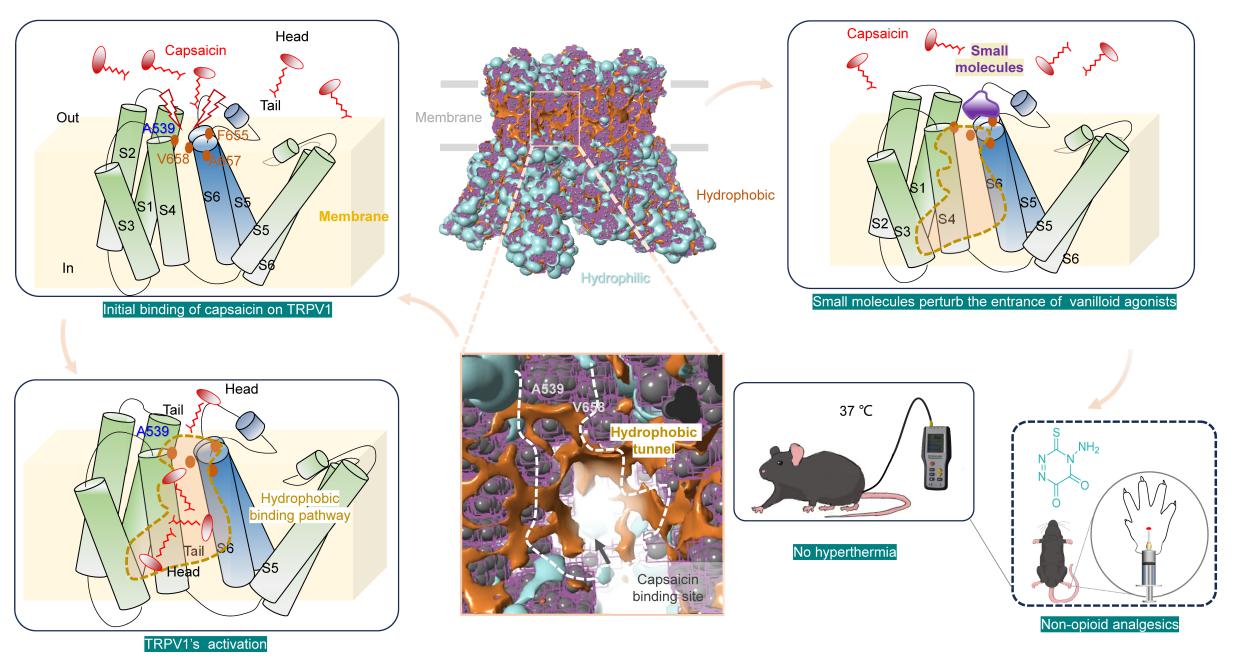
Figure 1. Molecular mechanism of capsaicin entry into the deeply buried vanillin-binding pocket within the TRPV1 channel
The paper lists Associate Professor Mengyang Sun and doctoral candidate Yujing Bian from our institute, postdoctoral researcher Xiaoying Chen from Zhejiang University School of Basic Medical Sciences, and master's candidate Xue Zhang from our institute as co-first authors. Professors Yue Yu and Fan Yang, along with Dr. Yuntao Lei from the School of Science, serve as co-corresponding authors. China Pharmaceutical University is the first corresponding institution.
Paper link: https://www.nature.com/articles/s41589-025-01966-5