


Recently, the research team led by Kong Lingyi/Yang Minghua and Zhao Yucheng from our university published their latest findings in the prestigious Journal of the American Chemical Society. The paper, titled “Biosynthesis of γ-Alkylidenebutenolide Derivatives Reveals an Atom-Deleting Lactone Ring Contraction by Dual-Enzyme Cascade,” details groundbreaking work in the field. Li Cuiping, a doctoral student at our university, and Fu Yuzhuang, a postdoctoral researcher, are the first authors of the paper. Professors Kong Lingyi, Yang Minghua, and Zhao Yucheng are the corresponding authors, with China Pharmaceutical University listed as the sole corresponding institution.
Characterized by an α,β-unsaturated γ-lactone ring, γ-alkylidenebutenolides are bioactive structural units widely present in plant and microbial secondary metabolites, yet their biosynthetic pathways remain largely unresolved. While investigating the biosynthesis of novel Aspergillus metabolites featuring a γ-alkylenebutylene lactone-cyclopentane bicyclic skeleton, the research team successfully uncovered a universal biosynthetic pathway for δ-substituted γ-alkylenebutylene lactones. In this biosynthetic process, a “two-enzyme cascade system” comprising the oxidase PesD and the DUF3237 family enzyme PesF achieves the ring-closure reaction from δ-lactone to γ-lactone via “atomic deletion,” representing an unprecedented carbon skeleton editing mechanism in chemical reactions.
Further X-ray crystallography and DFT calculations revealed that the key residue Glu99 in PesF sequentially mediates proton transfer and ring-opening reactions, enabling non-metal-dependent catalysis. This mechanism not only expands the functional repertoire of DUF3237 enzymes but also provides a novel model for biocatalytic ring contraction. This research establishes a novel paradigm for understanding “atomic-level framework rearrangement” in natural products and opens new avenues for complex molecular synthesis and enzyme engineering design.
This work was supported by the National Natural Science Foundation of China (NSFC) General Program and the Ministry of Education, Foreign Experts Bureau's “111” Program for Discipline Innovation and Intelligence Introduction in Higher Education Institutions.
Article link: https://doi.org/10.1021/jacs.5c13197
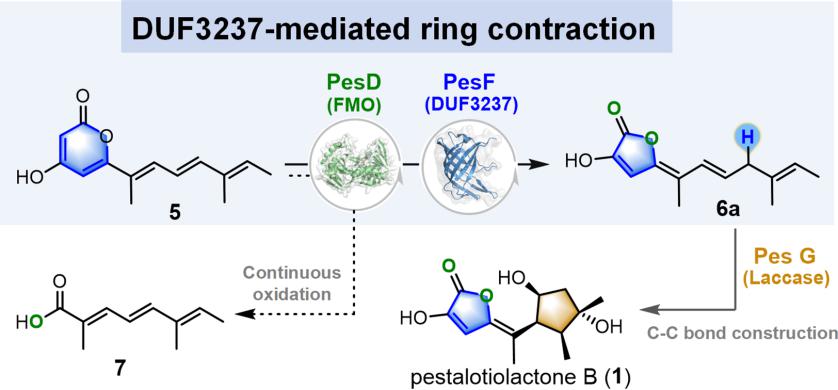
Schematic diagram of the γ-alkenylbutyrolactone biosynthesis pathway studied