


Recently, the research team led by Gao Xiangdong, Yin Jun, and Tong Yue from the School of Life Sciences at our university published their latest findings in the top-tier journal Science Translational Medicine. The study, titled “A modular metalloprotein vaccine for cancer immunotherapy in mouse models of breast cancer,” details their breakthrough work. Postdoctoral researcher Liu Dingkang (currently Distinguished Associate Professor at Chongqing Medical University) and doctoral candidate Tian Jing served as co-first authors. Corresponding authors include Researcher Yin Junxing, Professor Gao Xiangdong, and Associate Professor Tong Yue. China Pharmaceutical University is the sole corresponding institution.
Engineering proteins remains a critical step in studying the drugability of protein therapeutics. In recent years, the Gao Xiangdong/Yin Jun research group has achieved a series of advances in protein engineering through the artificial design of proteins (Journal of the American Chemical Society, British Journal of Pharmacology (4 papers), Journal of Controlled Release (3 papers), Advanced Functional Materials, etc.). Building on this foundation, they developed a tumor microenvironment protease screening platform utilizing the shielding properties of artificially designed flexible polypeptides. They proposed a long-acting shielding
targeted release prodrug strategy. This led to the construction of a fully protein-engineered prodrug vaccine system: the Protease-activated PSTAGylated in situ Tumor Vaccine (PPTV). This system employs human heavy-chain ferritin as a scaffold. Through genetic engineering, it fuses a selected mitochondrial damage peptide to its outer surface to induce immunogenic cell death (ICD), while encapsulating metal ions internally to activate cGAS-STING signaling. Engineered prodrugs were constructed using flexible PSTAG shielding peptides and protease cleavage sequences highly expressed in the tumor microenvironment. This design maintains “stealth” status during circulation while enabling selective “unsealing” by proteases in the tumor microenvironment, restoring receptor-mediated uptake and immune activity.
This study proposes a novel programmable tumor vaccine system centered on protein engineering and prodrug design, featuring high specificity, low toxicity, and strong translational potential, offering new insights for protein engineering and application.
This research was supported by the National Natural Science Foundation of China, the Key R&D Program of Xinjiang Uygur Autonomous Region, the “Double First-Class” Discipline Initiative, the Natural Science Foundation of Jiangsu Province, and the Basic Research Fund for Central Universities.
Full text link: https://doi.org/10.1126/scitranslmed.adr1777
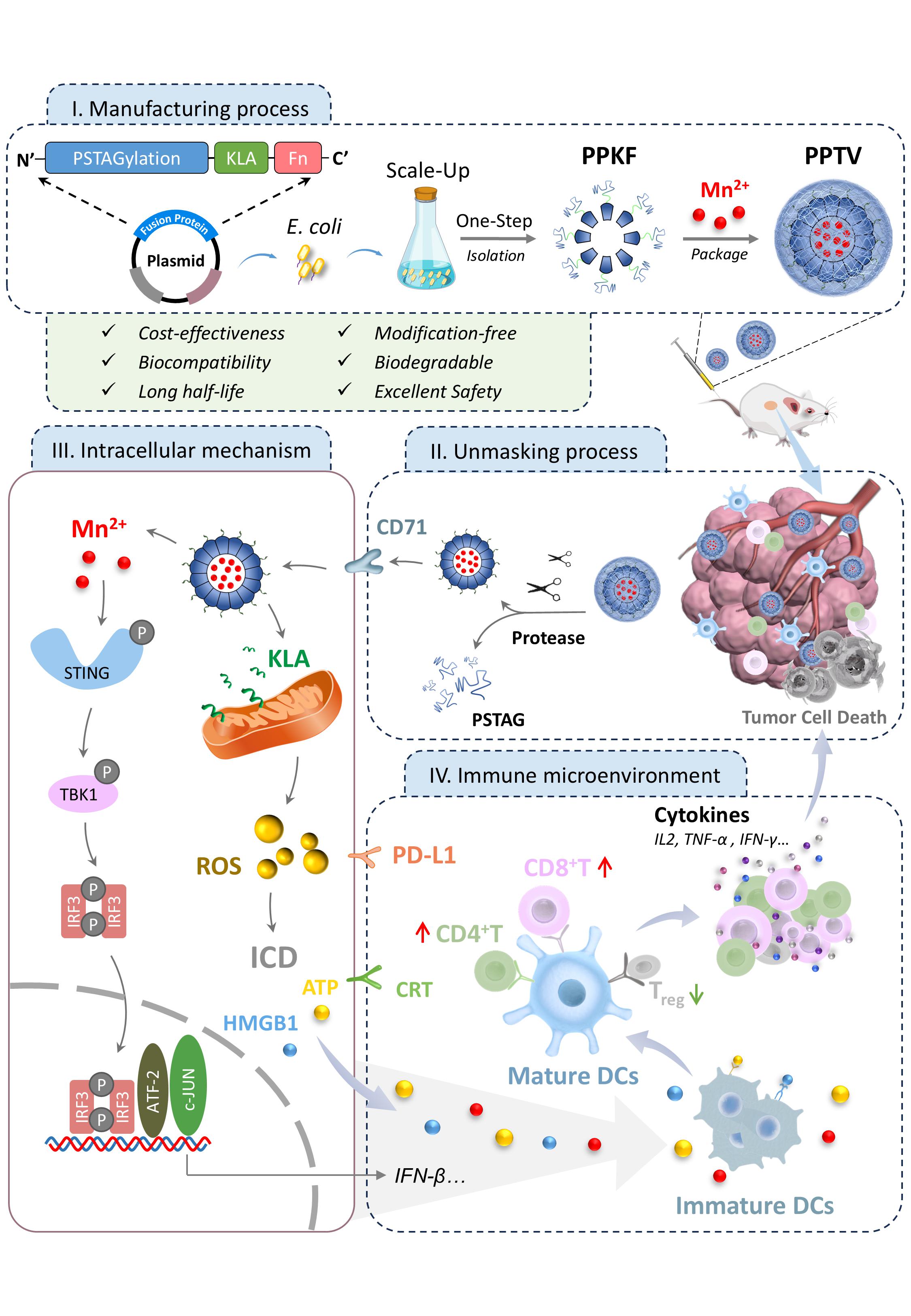
Schematic diagram of PPTV preparation and its application in antitumor therapy