


Recently, the research team led by Kong Lingyi, Zhang Chao, and Yu Pei from our university published a paper titled “Biomimetic vesicles engineered from modified tumor cells act as personalized vaccines for post-surgical cancer immunotherapy” in the premier journal Nature Nanotechnology. The study systematically proposes a novel strategy for personalized autologous vaccines against metastatic cancer post-surgery, based on natural product-mediated tumor cell reprogramming. This approach offers a groundbreaking solution for the rapid and precise implementation of post-surgical immunotherapy. Associate Researcher Yu Pei from the School of Chinese Medicine and 2020 Master's candidate Jin Zhiwei served as co-first authors. Professor Kong Lingyi and Researcher Zhang Chao were the corresponding authors, with China Pharmaceutical University listed as the sole corresponding institution.
Surgical resection remains the primary treatment for most solid tumors, yet residual or occult metastatic tumor cells post-surgery constitute the primary cause of tumor recurrence and cancer-related mortality. Personalized cancer vaccines, particularly dendritic cell (DC) vaccines, are considered ideal tools for eliminating residual tumor cells. However, traditional DC vaccines face bottlenecks including complex preparation processes, high costs, and limited in vivo migration and survival capabilities. In recent years, artificially derived cell-derived vesicles (ACDVs) have emerged as potential alternatives to DC vaccines. However, their clinical translation faces a core challenge: the high heterogeneity and unpredictability of patient-specific tumor neoantigens limit the development of truly “rapid, personalized” vaccines.
Addressing this critical scientific issue, Professor Kong Lingyi's team leveraged their systematic research in tumor vesicles (including exosomes and artificial vesicles) over recent years (Journal of Controlled Release, 2025; Molecular Cancer, 2024; Acta Pharmaceutica Sinica B, 2024; Pharmacological Research, 2024), proposed a novel technical approach: directly reprogramming autologous tumor cells obtained from surgical resection into antigen-presenting DC-like cells, thereby constructing personalized vaccine carriers from the source. The study revealed that STX11, a key molecule lowly expressed in tumor cells but highly expressed in immune cells (especially DCs), significantly upregulates MHC I and co-stimulatory molecules CD80/CD86 on the tumor cell membrane. By inducing STX11 overexpression, the team successfully obtained MHC I-high/CD80-high/CD86-high DC-like tumor cells and utilized their membranes to construct artificial DC-derived vesicular vaccines. This strategy preserves the patient-specific tumor antigen repertoire while introducing explicit immune co-stimulatory signals, enabling antigen-restricted CD8+ T cell activation. It demonstrated significant antitumor efficacy across multiple postoperative metastasis models (Figure 1).
Leveraging its expertise in natural product chemistry and fully utilizing the characteristics of natural compounds, the team addressed the critical clinical bottleneck of “preparation speed” for personalized vaccines through multidisciplinary collaboration. The study screened and identified the natural small molecule DPT (deoxypodophyllotoxin) as a functional alternative to the STX11 gene engineering strategy, rapidly inducing tumor cells to acquire DC-like characteristics. This DPT-based small-molecule reprogramming strategy significantly shortens vaccine preparation time while maintaining therapeutic efficacy comparable to gene engineering, substantially enhancing the clinical feasibility of personalized postoperative immunotherapy. This study organically integrates natural product regulation, tumor vesicle engineering, and personalized tumor immunotherapy. It systematically demonstrates a complete research chain from mechanism discovery and vaccine construction to validation in postoperative metastasis models, providing a novel strategy with translational potential for rapid-response immunotherapy against postoperative metastatic cancer.
This research was supported by the National Natural Science Foundation of China (General and Young Scientist Programs), the National Major Science and Technology Special Project for Four Major Chronic Diseases, the Jiangsu Province Outstanding Postdoctoral Program, and the Central Universities Basic Research Fund.
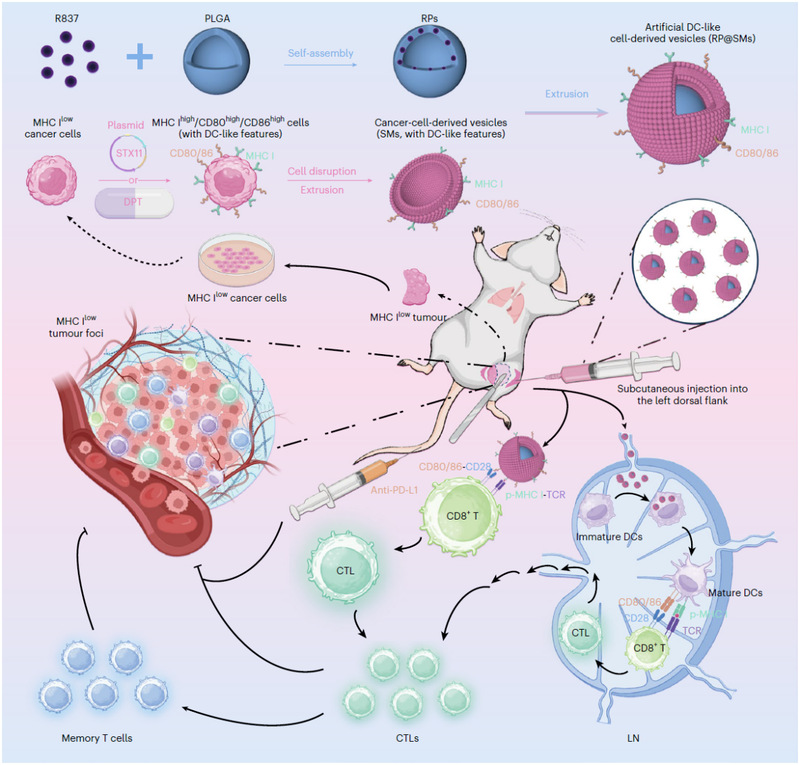
Figure 1 Schematic of artificial DC-like cell-derived vesicle construction and natural product-mediated personalized autologous vaccines for postoperative metastatic cancer
Full text link: https://www.nature.com/articles/s41565-025-02113-w